Author: Xinxue Wang
The story began in the spring of 2024.
During a casual chat, several members of the Plant Futures club came up with a simple yet moving idea: “Can we build our own garden with our own hands right here on campus?” This idea, like a seed gently falling into everyone’s hearts, quickly sprouted. We turned our attention to the south side of campus—a quiet open space between the IB and WDR buildings. Straddling the line between Phase I and Phase II of the campus, it was originally just a struggling green buffer zone, though some faculty and staff had already quietly started transforming it, planting a few flowers and rows of vegetable seedlings.
However, the land had no clear ownership at the time. To allow the garden to grow “legitimately,” the club’s faculty advisor, Professor Cai Xingshi, submitted a formal application to the Operations Department. Shortly after, this soon-to-be-born garden received its “birth certificate.”
At the start, Professor Cai came up with a “simple” method: he drew a grid on an Excel spreadsheet, where each cell represented one square meter, and opened it up for students to claim freely. To our surprise, as soon as the recruitment notice went out, all the “virtual plots” were snapped up within 24 hours—everyone’s passion for the land was far more intense than we had imagined.
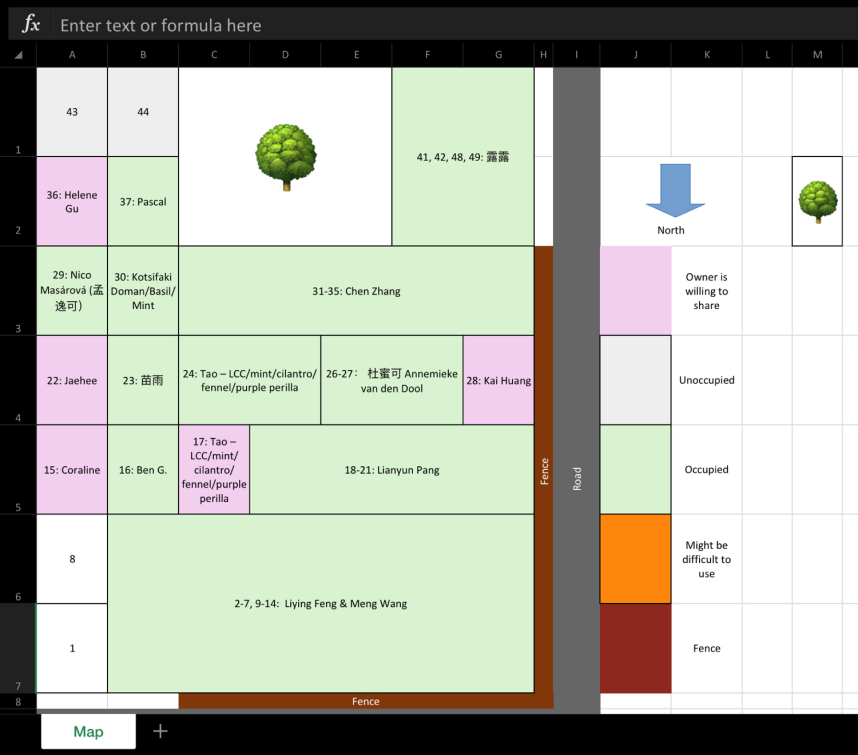
The garden on the Excel spreadsheet
But real farming is far more complex than simply clicking “claim” in a spreadsheet. When everyone arrived at the site enthusiastically with their tools, they realized the challenges had just begun: there were no physical markers on the ground, so as people planted, the boundaries between plots became unclear; some accidentally planted over the line, while others delayed starting their work. For the first few months, the garden was inevitably a bit chaotic.
Despite this, a few particularly dedicated gardeners persisted silently. They used their spare time to till the soil, water, and weed, caring for the land. Gradually, scattered patches of green connected into a whole, and the soil began to look alive. At the same time, the garden’s appearance became clearer through everyone’s joint efforts: fences were erected, tool cabinets were put in place, and someone even donated a hose, making watering much more convenient.
In the autumn of 2024, graduate student Xinxue Wang, who has a background in landscape architecture, joined us. She observed the issues and renovation potential of the community garden and brought us a clear and practical design proposal: the west side would feature neat “one-meter garden” boxes with clear boundaries that are easy to manage, making them perfect for beginners; the east side would retain open flat ground, leaving room for experienced growers to express their creativity freely; meanwhile, all tools and compost bins would be properly placed under the shade of trees on the south side, convenient for communal use without affecting the garden’s aesthetics. This practical and thoughtful layout continues to be used today.
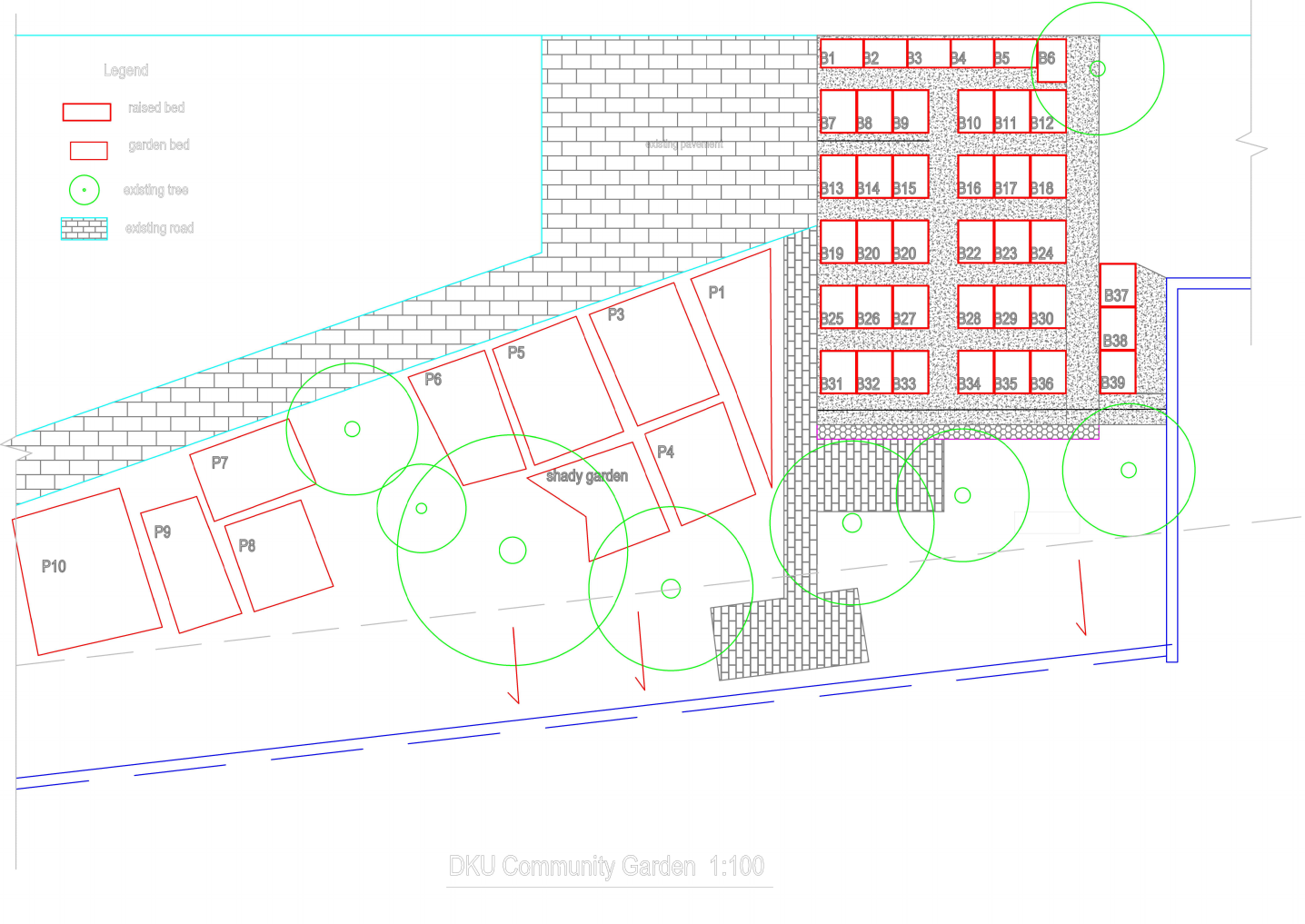
The garden design by Xinxue Wang
With funding from the DKU “Climate and Sustainability Initiative” (CSI) and assistance from the Operations Department, 36 planting boxes made from recycled logistics pallet collars were installed. We repaired the fences and set up an archway. As the garden began to take shape, we realized it was time to establish a more stable management team. Thus, the Community Garden Steering Committee (CGSC) was born. Professor Cai Xingshi, Xinxue Wang, Fan Li (Luisa), Meng Wang, Jiawen Cai, and Micky Zhang, who joined later, became the first core members. We sat together not just to discuss how to divide the plots, but to reflect on the meaning of the garden’s existence. Ultimately, we established its mission: to nourish DKU’s community culture and practice a sustainable lifestyle. It was also then that we progressively refined the plot allocation rules, the daily management covenant, and the “Gardener Code of Conduct.” From then on, the community garden offered freedom to plant, but within clear rules and boundaries.
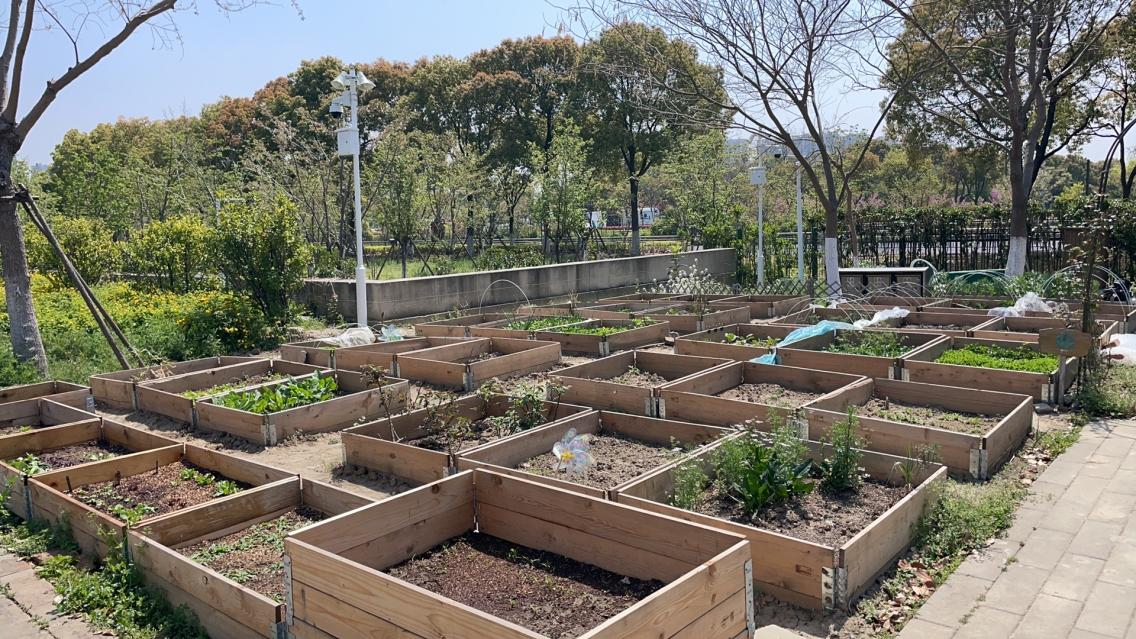
The newly installed planting boxes
On January 17, 2025, the garden officially opened. Executive Vice Chancellor Dr. John Quelch joined us and the students to select the first batch of official gardeners via a lottery. At that moment, a spring dream took firm root in the warm winter sun.
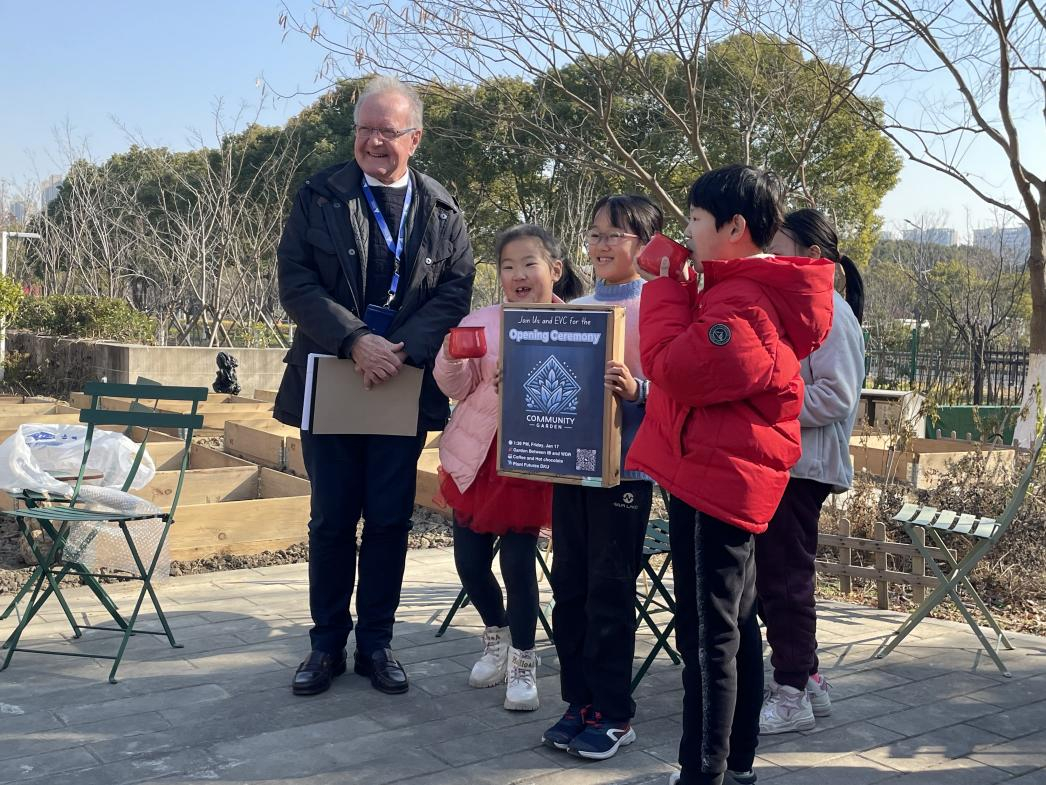
Dr. John Quelch hosting the opening ceremony
Once operations were on track, the garden gradually became a small hotspot on campus. Although some of the first batch of gardeners left due to graduation or busy schedules, the vacant land was always quickly filled by new enthusiasm. More and more “hidden” planting experts were discovered here, generously sharing knowledge, exchanging seeds, and helping one another. It wasn’t just plants that were thriving in the garden, but also the connections between people.
The CGSC also continued to learn and improve. We successfully applied for funding from the Starbucks Foundation’s “Future Star Community” project. This support allowed us to optimize facilities and enrich activities with greater ease, endowing the garden with longer-lasting vitality. We used this funding to pave smooth garden paths; from then on, rainy days were no longer muddy, and wheelbarrows could enter and exit easily. We purchased new tool cabinets and upgraded the compost bins, making storage tidier and the recycling of plant waste smoother. We handed the plot at the garden entrance over to gardening experts Xin and Luisa to plant flowers, making the community garden even more beautiful. Activities in the garden became increasingly diverse: we invited agricultural experts from Yuefeng Island for on-site guidance, organized visits to the Biolan composting factory, and hosted the “University Community Garden Symposium” in late November. This event brought together faculty and students from five universities, including DKU, Peking University, and the University of Glasgow, for the first time—expanding the dialogue on campus community gardens to a broader stage.
On November 1, 2025, the new Steering Committee formally took the baton. Xinyao Gao, Professor Coraline Goron, Wanjian Li, Xue Qiu, and Pengcheng Tan became the new guardians, injecting fresh perspectives and vitality into the garden. This smooth transition also marked that the garden truly possesses a sustainable life that belongs to the community—it no longer relies on the enthusiasm of its founders, but has become a shared ground where everyone can participate and belong.
Looking back over this past year or so, this garden went from nothing to something, from vague to clear. It never relied on grand blueprints, but on specific individuals and their sincere efforts, time and time again. It has long been about more than just planting and harvesting; it is about the trust built through labor, the warmth passed through sharing, and the friendships that have grown from the soil.
The story continues. Every hand reaching toward the earth, every seed buried in the soil, is writing a new paragraph for it. And this garden will forever save an inch of soil, a patch of shade, and a possibility of growth for the next person willing to bend down and farm.